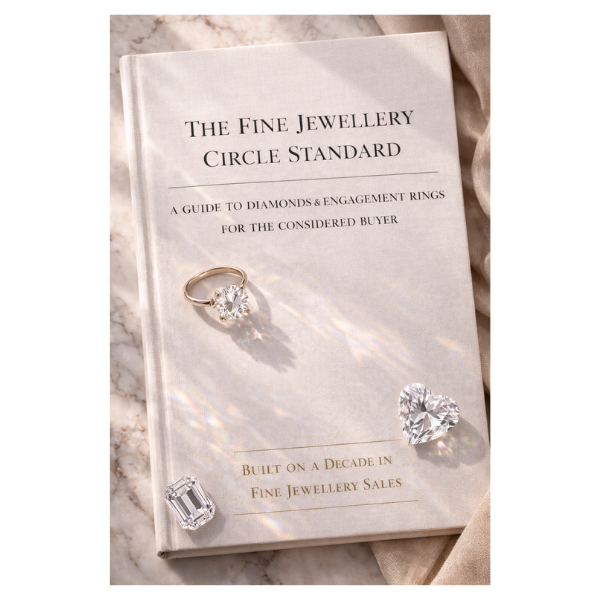
what the guide includes
The Fine Jewellery Circle Standard teaches you to look at diamonds differently. Not as a checklist of grades, but through three evaluative lenses: Structure, Performance, and Presence. It moves beyond the 4Cs not to dismiss them, but to place them where they belong: as contributors to a larger framework.
Structure. The architecture of the diamond: proportions, shapes, and faceting styles. The engineering decisions made by the cutter that no grading report will fully capture. Structure determines potential.
Performance. What the eye actually experiences. Light performance comes first: brilliance, fire, scintillation - none of it certified, all of it consequential. The 4Cs follow, explored in depth as contributors to visual performance: cut, colour, clarity, and carat in real light, not on a certificate.
Presence. What the ring becomes, in context, on the hand, over a lifetime. Setting, proportion, metal choice, and design harmony. The finest engagement rings succeed as unified designs. This is the lens that determines whether a ring endures.
The guide covers each lens in depth, alongside natural versus lab-grown diamonds, hallmarks and laser inscriptions, ethics in fine jewellery, aftersales care, and a cultural history of the engagement ring. Built on a decade in fine jewellery sales.
WHO THE GUIDE IS FOR
This is not a checklist. It is not a trend report. It is a reference for people who make considered decisions and want to understand what they are buying before they buy it.
It was written for the person about to make one of the most significant purchases of their life - but also for the curious buyer, the investment-minded client, and the jewellery professional who wants a deeper fluency than the industry typically offers.
You do not need prior knowledge to use it. You need the willingness to develop a trained eye, to move beyond grades and certificates and learn to evaluate a diamond the way people who work with them every day actually do. That means understanding structure, performance, and presence. Technical standards alongside visual judgment, proportion, and long-term value.
Read it from beginning to end to build a complete foundation, or return to specific sections as you move through the process. Either way, it will change how you look at diamonds and how you feel walking into a consultation.
At around 1% of the value of an average engagement ring, it is a modest investment that protects a far more significant one. The difference between buying with confidence and buying under pressure is, more often than not, simply knowing what to ask.
Contact
Interested in working together or sharing your thoughts? Fill out some info and we will be in touch shortly.